Use this page to learn how to apply electronic signatures to Participant records in OpenClinica.
Roles: Investigators (a site-level role) and Data Specialists (a study-level role) can sign Participant records. Custom roles based on these roles may also sign records.
Overview
You can sign Participant records at the following levels:
- Study Event level
- Participant level
- Bulk level (multiple Participants at one time)
Signing confirms that data entry and review are complete according to protocol and regulatory requirements.
Eligibility Requirements for Signing
Event Eligibility
A Study Event is eligible for signature only when all of the following conditions are met:
- All required Forms in the Event are marked Complete.
- All non-required Forms are marked Complete or Not Started.
- The Study Event is in a final state: Not Scheduled, Complete, Stopped, or Skipped.
Archived or Removed records cannot be signed.
Participant Eligibility
A Participant record is eligible to be signed (individually or in bulk) only if all Events for that Participant meet the Event eligibility criteria listed above.
Electronic Signatures with SAML Single Sign-On (SSO)
ℹ️ Note: Behavior differs depending on whether SAML SSO is enabled in your OpenClinica environment.
- SAML SSO enabled: You sign records using a Signature Code and your OpenClinica username.
- SAML SSO not enabled: You sign records using your OpenClinica username and password.
Signature Codes (SAML SSO Enabled)
When SAML SSO is enabled, Investigators, Data Specialists, and custom roles based on those roles must use a Signature Code.
Generate a Signature Code
- On the Electronic Signature screen, click Send a new signature code to my email.
- OpenClinica generates a unique Signature Code and sends it to the email address associated with your user account.
Signature Code Rules
A Signature Code:
- Is never displayed within OpenClinica.
- Cannot be retrieved after it is sent.
- Can be reused for subsequent signings.
- Can be replaced at any time by generating a new code.
⚠️ Warning: You are responsible for securely storing your Signature Code.
Sign a Study Event
You can initiate signing from multiple locations.
Option 1: From the Participant Matrix
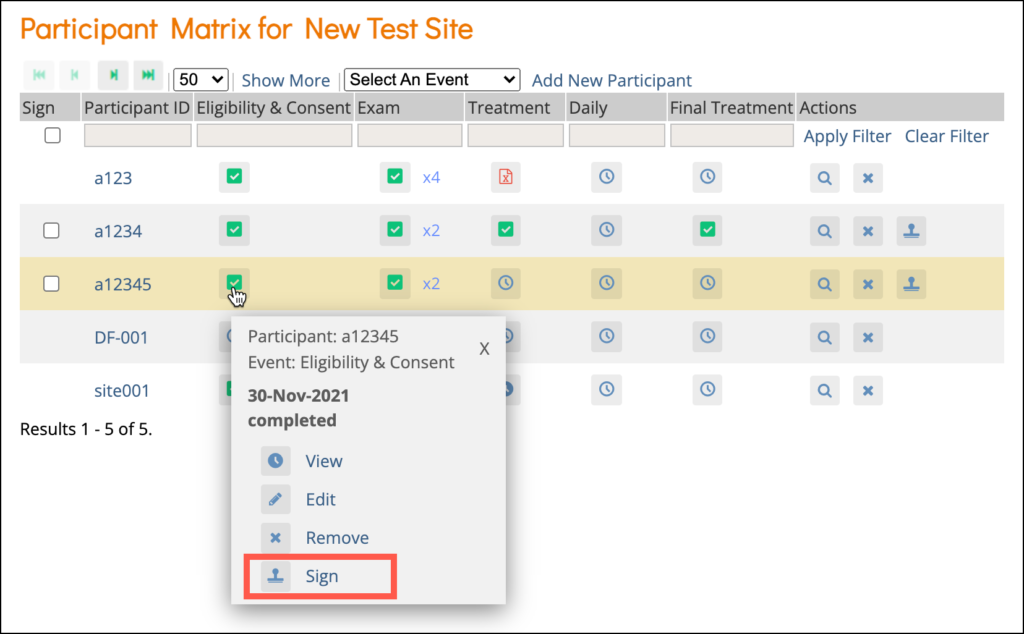
- On the Participant Matrix, select the Event you want to sign.
- From the drop-down list, select Sign.
The Sign option appears only if the Event is in a final state.
Option 2: From the Participant Details Screen
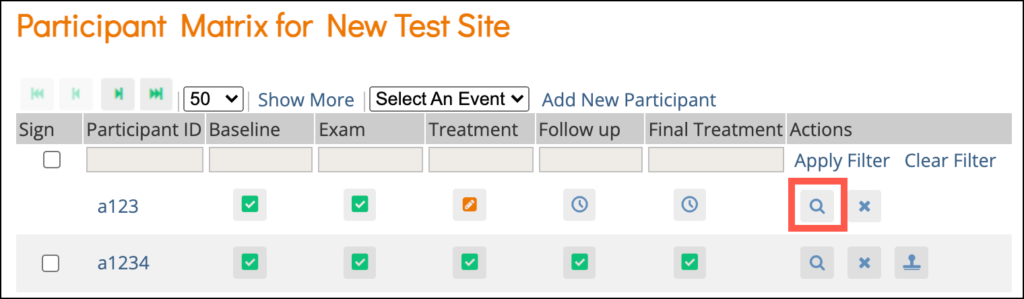
- Click the View icon for the Participant.
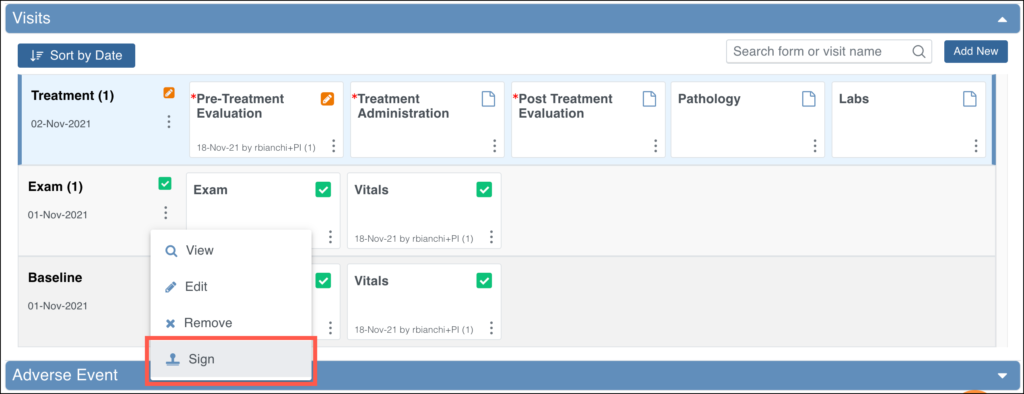
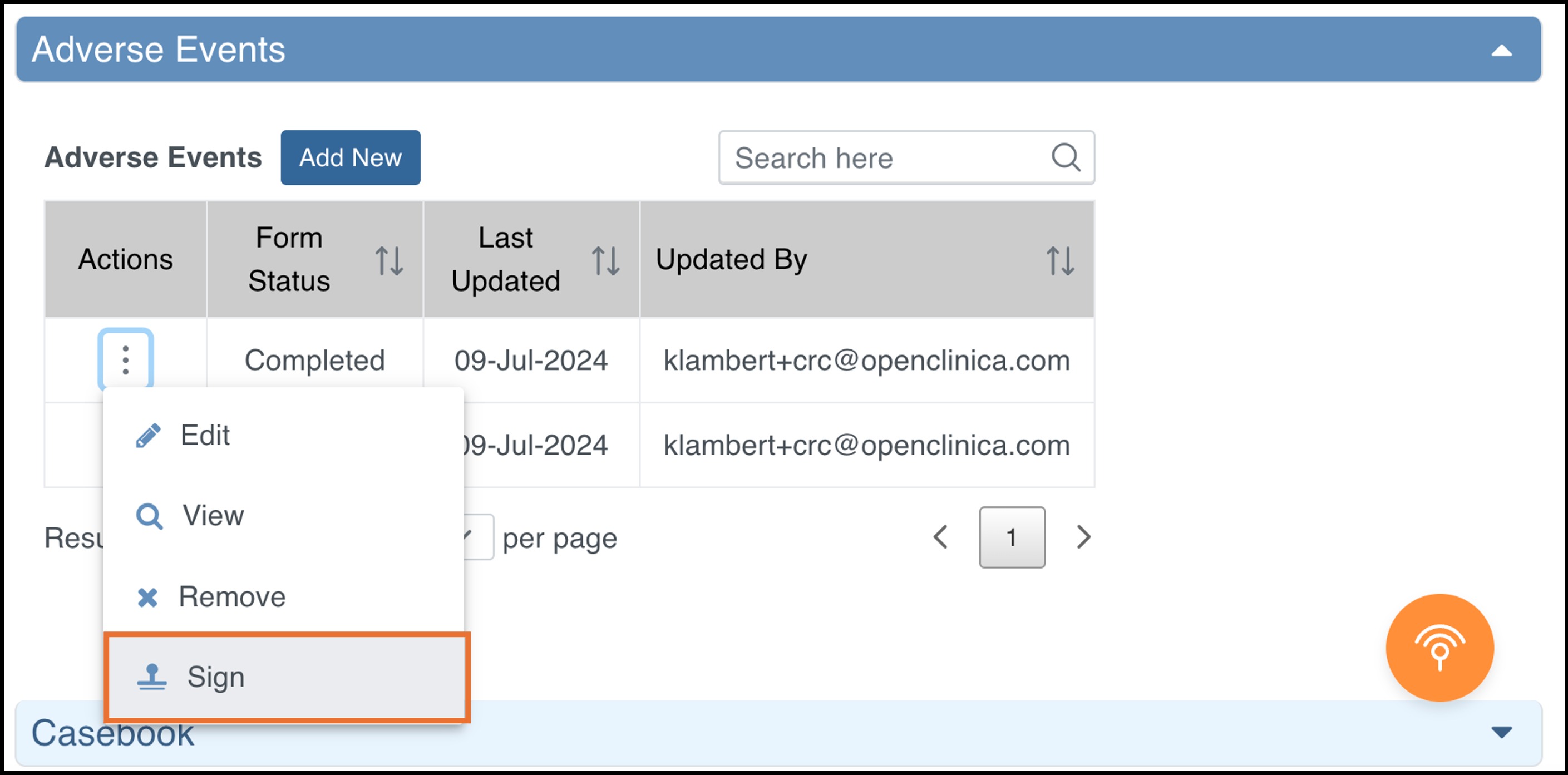
- Locate the Event and select Sign from the Actions drop-down list.
Option 3: From the Update Study Event Screen
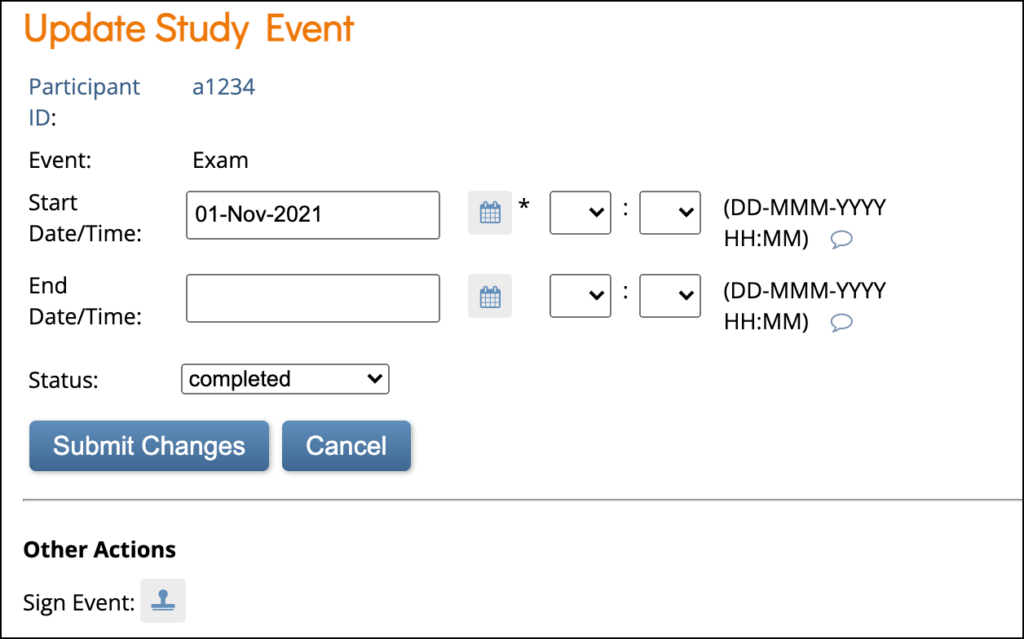
- Select Edit from the Event Actions menu.
- On the Update Study Event screen, click Sign Event at the bottom of the page.
For Common Events, click the Sign icon in the Actions column on the Participant Details screen.
Complete the Electronic Signature
- Review the Electronic Signature screen, which displays:
- The attestation text
- Your full name
- A list of the records you are signing

- Enter your credentials:
- SAML SSO enabled: Enter your OpenClinica username and Signature Code.
- Non-SSO environments: Enter your OpenClinica username and password.
- Scroll to review the list of Forms in the Event and the query status for each Form.
- Click Submit to complete the signature.
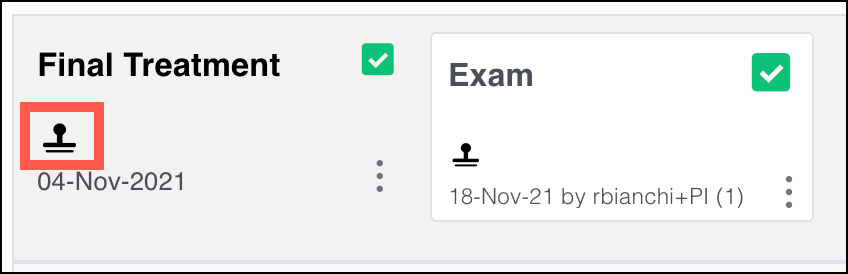
Outcome: You are returned to the Participant Details screen, where the Signed icon appears on the Event.
Forms Included in an Event Signature
ℹ️ Note: The attestation that appears when signing the Participant Event includes the forms listed above the User’s Full Name on the Sign Event screen. The forms available to sign include all forms for the event, except the following:
- Forms the signing user cannot access due to permission tags or the Hidden attribute of the form
- Forms that were started in the event occurrence but are currently Archived or Removed
- Forms in the event occurrence that were never started or have Not Started status
For more information about form access permissions, refer to Managing Form Access and Permissions.
Signature Errors (SAML SSO Enabled)
If a signing attempt is unsuccessful, the record remains unsigned and an error message is displayed:
- Invalid Signature Code – If the code entered is not valid, the following message appears:
“The Signature Code you have provided is not valid. Please enter a valid code. You can use the link below to generate a new one.” - Expired Signature Code – If the code has expired, the following message appears:
“The Signature Code you have provided is expired. You can use the link below to generate a new one.” - Invalid Username
If an invalid username is entered, the record is not signed and an invalid username message is displayed.
Sign Participant Records for All Events for a Participant
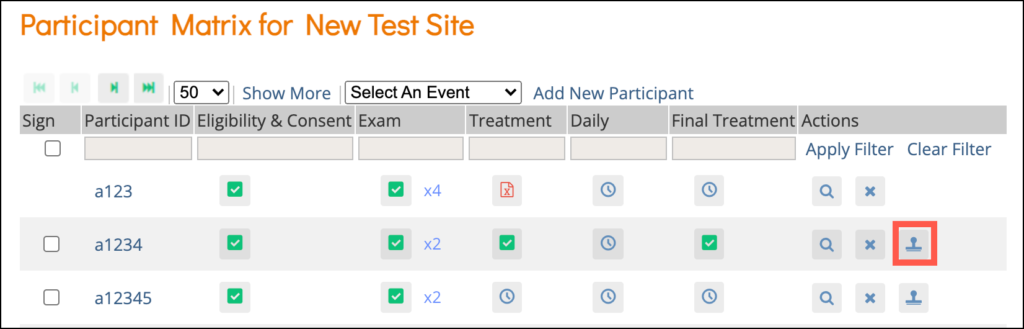
If all Events for a Participant are in a final state (Not Scheduled, Complete, Stopped, or Skipped), you can sign the entire Participant record.
- On the Participant Matrix, click Sign to sign all eligible Events for that Participant.
Bulk Sign Multiple Participant Records for All Events
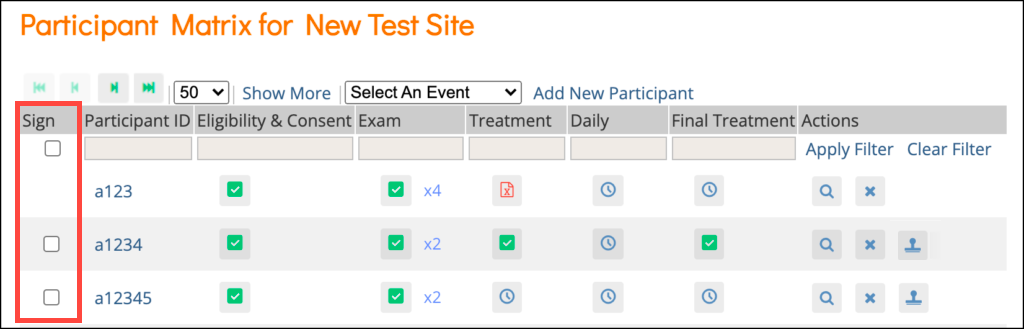
When multiple Participants are eligible for signing:
- A checkbox appears in the Sign column.
- The Sign option is also available in the Actions column.
Select multiple Participants using the checkboxes, then complete the signing process to apply signatures in bulk.
Multiple User Signatures
Multiple users can sign an Event, so even if an Event has already been signed, the Sign action will still be available. If there are multiple signatures, all active signatures that have been added since the Event last became signed will display on the Form as well as in the Audit Log.
When Events Become Unsigned
An Event becomes unsigned if any of the following occur:
- A user makes changes to an item on a Form after the Form was signed.
- The Event status was changed from Completed, Stopped, Skipped or Not Scheduled after being signed. (This also changes the Participant status from Signed to Available and the Event Status to Completed.)
- A user archives/unarchives the Form, unless the Form had a status of Not Started.
- A user removes/restores the Form.
ℹ️ Note: Changing the version of a Form will only unsign the Form if a user changes data.
Cancel a Signature
You can cancel the signing process at any time.
Result: The record remains unsigned and no signature is applied.
Was this article helpful?
That’s Great!
Thank you for your feedback
Sorry! We couldn't be helpful
Thank you for your feedback
Feedback sent
We appreciate your effort and will try to fix the article