Before you build a Case Report Form (CRF) in Form Designer, define a consistent naming convention for your item names. Planning your item names in advance helps you create predictable, readable object identifiers (OIDs) and maintain consistency throughout your study.
In OpenClinica, the item name you enter is used to generate the item's OID. The OID is the permanent internal identifier used in the database, data exports, ODM/XML, and the API. 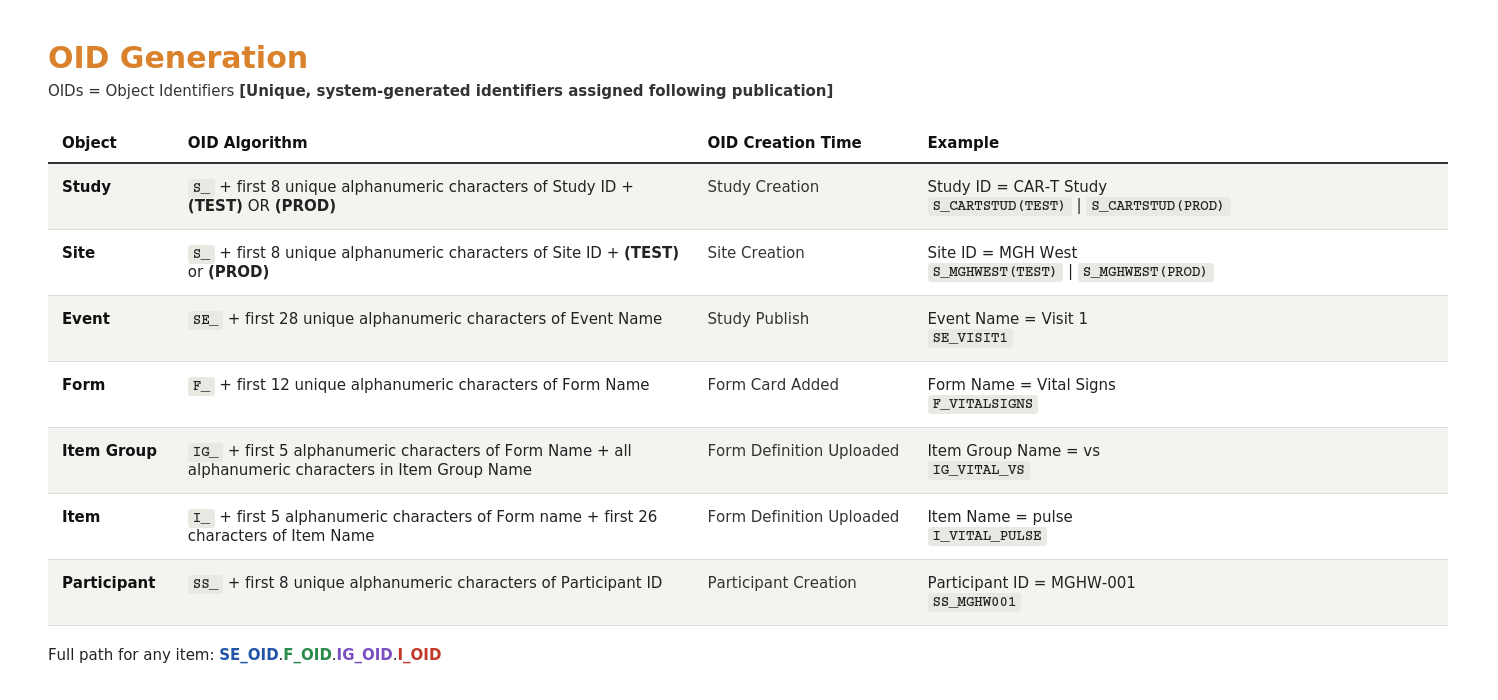
The item OID automatically incorporates the OID generated from the first five characters of the CRF name, so you do not need to add a form prefix to the item name.
Planning a clear and consistent naming convention before you begin helps you:
- Avoid rework later in the study.
- Keep exported datasets readable and predictable.
- Make OIDs easier for downstream data and statistical teams to interpret.
- Maintain consistency across forms and study events.
- Reduce unpredictable or automatically generated identifiers when form names share the same first five characters.
Plan Your Item Names and OIDs Before Building
Follow these steps before you begin creating your CRFs:
- List every form and study event in your study, for example, from your protocol's Schedule of Activities. Review the items you need to include in each form and identify a consistent naming approach.
- Choose a consistent naming convention for item names. Use short, descriptive variable names in a consistent format, such as uppercase letters with underscores:
AGEGEST_WKSWEIGHT
- Define your item groups consistently, since group names also contribute to the generated OID.
- Create a data dictionary, such as a spreadsheet, with one row for each item. Include the following information:
- Form
- Item group
- Proposed item name
- Question label
- Data type
- Code list (for example,
1 = Yes,0 = No) - Validation rules
- Review the naming convention with your team before you begin building forms to ensure it is applied consistently across all CRFs.
- Build each CRF in Form Designer by copying the pre-approved item names from your data dictionary. This helps ensure that the generated OIDs are predictable, consistent, and easy to interpret in downstream data exports.
Was this article helpful?
That’s Great!
Thank you for your feedback
Sorry! We couldn't be helpful
Thank you for your feedback
Feedback sent
We appreciate your effort and will try to fix the article